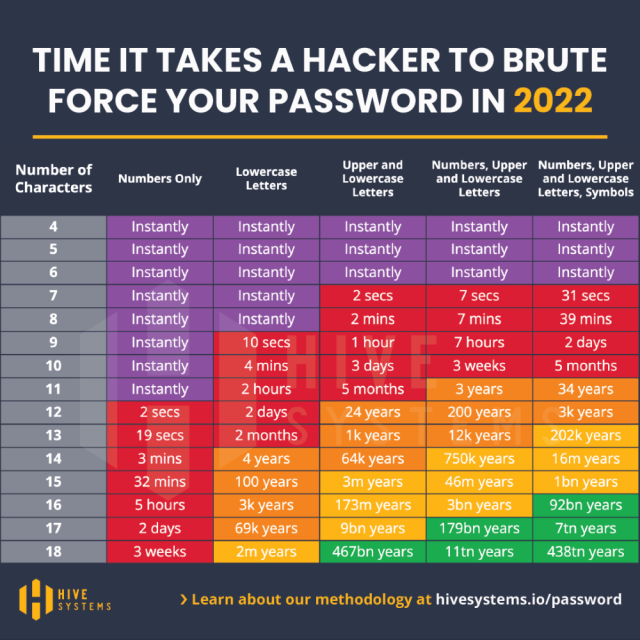
Short answer: you can’t. But you can slow the attacker down by using strong passwords. How strong? Refer to the table below:

And don’t re-use your passwords. I suggest the free Bitwarden for managing them.
Short answer: you can’t. But you can slow the attacker down by using strong passwords. How strong? Refer to the table below:

And don’t re-use your passwords. I suggest the free Bitwarden for managing them.
As I’ve mentioned before, it’s really a headache trying to sync Plex media to Trakt without paying extra for both Trakt VIP and Plex Pass.
Fortunately, I was able to make PlexTraktSync work with my current setup:
Opening the terminal, I created directories in /docker/plextraktsync like so: Continue reading How I made PlexTraktSync Work for my Setup? (Docker + Portainer)

In 2020, Google introduced the fourth generation of its Chromecast, dubbed as Chromecast with Google TV (CCwGTV), which was the first time it came with Google TV (a modified Android TV user interface) and a remote. So, in the world of Google TV’s (and Android TV’s in general), is there still a need for the Google Cast function?
Here are the reasons why we still need the Google Cast around:
The one thing I love about the Chromecast is the ability to queue up videos you want to watch from your YouTube mobile app. Oftentimes, when I want to YouTube and chill, I open a video on my YouTube mobile app, cast that thing to my TV with a Chromecast, browse more of the homepage of the YouTube app, then add as many more videos as I like to watch next to the queue.
Although you can queue up videos as well in the web version of YouTube, the same is not true on Android TV’s. I just find it so inefficient to have to quit the video you’re currently watching, browse though the homepage, and select the single video you want to watch next. Continue reading In the world of Google TV’s, why do you still need the Chromecast function?

The Beelink S1 and Mi Notebook Pro (15″ 8th Gen Intel Core i5-8250U with 8GB RAM) are two of the computers I own. Finding Windows drivers for these devices are hard to find, especially after reinstalling the OS. That’s why I’m sharing the drivers I got saved here, hope you’ll find them helpful:
The Beelink S1 drivers are also applicable to Beelink models AP34, AP34 Pro, M1, and AP42.
Starting today, February 4, 2022, you can no longer enjoy the Smart unlimited data for just P499 per month with your Smart Rocket Sim.

Apparently, it was a promo for like 4 or 5 months only. Now back to regular programming. So what replaced the promo package?»
Evernote has brought me so much disappointments that I wanted to ditch it as my primary note-taking app in favor of Notion.
Recently, I got a new computer (an i7 Intel NUC 11), and I opted to have 32GB of RAM installed. Now, coming from an 8GB-RAM laptop, I didn’t expect this new Windows machine to hit its memory limit anytime soon with my normal usage. Until I installed the Notion desktop app.

A few moments after installing Notion, Continue »
I’ve been a Distro-hopper, like 14 years ago, especially when I was new to Linux. I’ve tried and tested a good number of distributions: if you found them on the front of Distrowatch back then, there’s a good chance I have tried them out. Since then, my computers may have become a lot more powerful, but if I really needed to install one, I limited my selection to more reliable systems, like Ubuntu and its derivatives, like Xubuntu, Lubuntu and Mint.
But now, I’m inclined to do another round of Distro-hopping once again, and here are the distributions on the top of my list:
Any other distros I’ve missed?
Magic Data is Smart’s take on GOMO that offers fixed data volume without an expiration period.
The fact that Smart doesn’t have a dedicated web page outlining the mechanics of their Smart Magic Data addon speaks volumes about its commitment to keeping the addon available to its regular customers in the near future. The option to register/subscribe disappeared recently from its Gigalife app as well.

Last option to subscribe to Smart Magic Data is via USSD code. Here are the steps to subscribe »
Sometime in the middle of 2020, Airtable made available to select new users the Creator Plan. It was not available to everybody. No announcements were made about it. No documentation whatsoever.

So how to describe this plan? One user emailed the dev team, and this is what she got in response:
The Creator plan is a current experiment that gives a new solo user almost all of including blocks, without the usual time constraints of a Pro trial.
Once the person adds collaborators to the Creator workspace, it morphs into a 30-day Pro trial, to experience the power of Airtable Pro with others. Once users are added to a workspace, all users will have 30 days of premium use before payment is required.
*If no collaborators above read-only are added, the Creator-plan (Pro features) will remain in effect indefinitely.*
If I were to describe the plan briefly: it would be closest to the Pro Trial plan without the time constraints. Yet, let me breakdown the features and compare the Airtable Creator Plan to the other plans the best I could. I’ll update this post as more info come my way. Continue reading Airtable Creator Plan, are you one of the lucky few?