Searching Conrado Valix

Yeah, sounds like a movie (Searching Bobby Fischer). I should have changed the title to “Googling Conrado Valix”. Nah, nevermind.

bookI was wondering of late why there were just too many people who maybe were lost in the cyberspace and found their way to my entry regarding the Financial Accounting I, 2006 Edition by Atty. Conrado Valix and Jose Peralta. These visitors are mostly students from schools in different parts of the country (Philippines), who are (maybe) fanatics of Atty. Valix (okay, I am a fan myself). My blog was even mistaken for a fan site or something like that.

Then, I tried googling for the keyword “Conrado Valix” and guess what I discovererd:

  • Google – No. 1 in the search result page.
  • Yahoo! – No. 1 in the search result page.
  • MSN – No. 3 in the search result page.

Refining the search query yielded in a more interesting result. For a keyword “Financial Accounting by Conrado Valix”, my site ranked simply number one in all the big three search engine sites! (Note that these results change over time)

So that explains it, huh!

That should surely explain The J Spot’s entry on “Why Celebrities Should Blog“. He also cited another reason here.

Conrado Valix, being a public figure especially to accountants from college students to professionals, should start blogging. By this manner, it will pave the way at which students and professionals alike can contact him. It can be a ground where he can solicit feedbacks from readers of is “renowned” books on accounting.

Nonetheless, it’s even more ironic to note that CPAR (CPA Review School of the Philippines), being an established institution in the world of Filipino Accountants where Atty. Valix is one of the founders and the current director, doesn’t have a website (I think I’ve already said before). It’s one of the review centers that has produced and is still producing the best accountants in the country (or maybe even in the whole world), and yet it doesn’t yet have a space in the world wide web. (Or maybe it has, but it was not just optimized for search engines, I don’t know. If that’s the case, time to hire an SEO professional.) Imagine just how many students are maybe searching for its site everyday. Thus, maybe lost reviewees (and revenue).

Access to internet nowadays are becoming more widespread and cheaper. One should really reevaluate its marketing strategy.

(What do you think Domeng? –if you read this post)

The Difference Between IFRS and IAS

This is the question that oftentimes pops up from a middle of nowhere…

What basically are the differences between the International Financial Accounting Standards (IFRS) and International Accounting Standards (IAS)? Or, should we rephrase the question, are there any differences at all?

Well, there are differences, of course. And the major difference is that the IAS’s were issued by the International Accounting Standards Committee (IASC) from 1973 to 2001, while the IFRS’s were issued by the International Accounting Standards Board (IASB) from 2001 onwards. The IASB is basically the successor for IASC.

When IASB was installed in 2001, it adopted the existing IAS and decided to name any future standards as International Financial Reporting Standards. Consequently, IAS 1 Presentation of Financial Statements defines IFRS as standards and interpretations adopted by the IASB.

Now, IFRS in a broad sense comprise:

  • Framework for the Preparation and Presentation of Financial Statements – stating basic principles and grounds of IFRS
  • International Financial Reporting Standards (standards issued after 2001)
  • International Accounting Standards (standards issued before 2001)
  • Interpretations originated by the International Financial Reporting Interpretations Committee (IFRIC) or the former Standing Interpretations Committee (SIC)

In My Humble Opinion (IMHO)

I have to be explicit that these are just my opinions. If you trust it, then thank you. If not, then make your own research! (LOL!)

So the new IFRSs standards are in addition to (on top of) the IASs, won’t there be any contradicting standards/principles between the two as a result of the adoption of IFRS?

Just as the former IASC altered some of its provisions and withdres some IAS numbers from its set of standards over the years, any contradicting principles from the new IFRS will supersede that of IAS. One basic example is the IFRS 3 and IAS 22, which are both titled, “Business Combinations”.

Of course, there are standards in the IFRS that provide rule over some grey areas or a “no mention” in the IAS, just like the identification, measurement, presentation and disclosure of non-current assets held for sale (IFRS 5).

In fact, when contradicting standards are issued, the older one is removed from the complete set of standards. Look at the latest complete list of standards and IAS 22 is not there anymore.

I have been full compliant with IAS in the previous years, do I still have to apply IFRS 1 (First Time Adoption of IFRS), and thus present comparative information and other disclosures required by IFRS 1 in my next financial statements?

Under the Scope of the standard, paragraph 3, if you have not stated compliance with IFRS in an “explicit” and “unreserved” statement in any of your previous financial statements, then you have to comply with and follow the disclosure requirements of IFRS 1. If you have been full compliant with IAS, then preparing the disclosure requirements of IFRS 1 would not be that cumbersome.

Conclusion

Try googling for the difference between IFRS and IAS, and it will lead you nowhere. I mean, basically there are no resources in the internet that can give you a precise distinction between the two. Such question just seems like improper. It’s like comparing a chicken against an egg, when in fact the former just simply evolved from the latter. You can’t plainly make a head-to-head comparison.

Remember, comparing IFRS vs. IAS is not like comparing IFRS vs. US GAAP. The latter is completely a different story.

Remembering the Walk

Sometimes, when I just have nothing to do, I just keep this film replaying on my laptop…

walk to remember

Love is always patient and kind,
It is never jealous,
Love is never boastful nor conceited,
It is never rude or selfish,
It does not take offence,
And it’s not resentful.

Love takes no pleasure in other people’s sins
But delights in the truth
It is always ready to excuse,
To trust, to hope, and to endure
whatever comes.

The Superhero Inside

In my friendster account, I indicated there that one of my favorite books is “The Encyclopedia of Superheroes”. Well, I just can’t actually think of anything and also would like to sound less corny, you know.

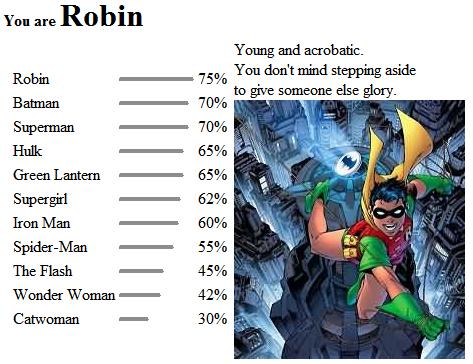
Anyway, found this site that evaluates which Superhero you should be based on your personality. You just have to answer some questions that better describe your characters. And here are my results:

superhero

Huh, I am more of a “Robin” than “Superman”? How can that happen? It means I don’t have superpowers. Instead, I have skills.

And I won’t mind stepping aside to give someone else glory? Is that the personality of Robin? Well, maybe stepping aside to give Batman the glory…

Anyway, what about you, which Superhero are you?

Click here to take the Superhero Personality Quiz

Forty Richest Pinoys

Forbes magazine, in its latest Asian edition, released a list of top 40 Richest Filipinos.

Of course, it’s not surprising at all to note that at the top of the list are the Filipino-Chinese businessmen. The richest Pinoys with the corresponding net worth are as follows:

1. Henry Sy – $4.0 billion
2. Lucio Tan – $2.3 billion
3. Jaime Zobel de Ayala – $2.0 billion
4. Eduardo Cojuangco – $840 million
5. George Ty – $830 million
6. John Gokongwei – $700 million
7. Tony Tan Caktiong – $575 million
8. Andrew Tan – $480 million
9. Emilio Yap – $350 million
10. Oscar Lopez – $315 million
11. Enrique Razon Jr. – $285 million
12. Andrew Gotianun – $280 million
13. Enrique Aboitiz – $275 million
14. Alfonso Yuchengco – $225 million
15. Menardo Jimenez – $210 million
15. Gilberto Duavit Jr. – $210 million
17. Ramon del Rosario – $205 million
18. Felipe Gozon – $180 million
19. Beatrice Campos – $160 million
20. Luis J. L. Virata – $150 million
21. David M. Consunji – $145 million
22. Bienvenido Tantoco Sr. $140 million
23. Betty Ang – $115 million
24. Manuel Villar – $110 million
25. Mariano Tan – $100 million
26. Rolando and Rosalinda Hortaleza – $90 million
27. Oscar Hilado – $85 million
28. Vivian Que Azcona – $80 million
29. Manuel Zamora – $75 million
30. Magdaleno Albarracin – $73 million
31. Jesus Tambunting – $70 million
32. Frederick Dy – $65 million
33. Tomas Alcantara – $60 million
34. Lourdes Montinola – $50 million
35. Salvador Zamorra – $45 million
36. Antonio Roxas – $40 million
37. Wilfred Steven Uytengsu Sr. – $38 million
38. Philip T. Ang – $35 million
39. Marixi Prieto – $30 million
40. Manuel Pangilinan – $25 million

See the inquirer.net report.

The NBA Live 2007 is Gaining Speed

It can be noticed that my entry on NBA Live 2007 – The Final Straw is gaining speed in my Most Popular Posts. It is now third on that list.

I was even surprised to have an unknown commentator trying to voice out his disappointment with the game. Unknown in the sense that I don’t know him personally. But of course, everyone is most welcome (except spammers) to comment here!

This wonder led me to investigate more how did he find out about my site. Then, I found out that:

  • If you google search for a keyword “NBA Live 2007 bugs”, you’ll find my site third in the google search results page.
  • If you google search for a keyword “NBA Live 2007 glitches”, you’ll find my site seventh in the google search results page (fifth, if you exclude the indented lists).

So, how does this make sense? Is my site really that popular? (Hehe) Well, I can offer a reason for this though. Maybe I was just the only blogger to touch on the topic of the glitches and bugs of NBA Live 2007, plus some makulit commentators and die-hard NBA (Live) Fans like Lou Franz and Percival who are leaving those comments, adding to the popularity of the post.

Anyway, thank you to all who have left comments! And Happy 2007!

Testing Out EF85mm f1.8 USM for the New 2007

First of all I would like to greet all my avid readers a Happy New Year, a Happy 2007!

My first prime lens, the EF 85mm f/1.8 USM lens, according to reviews produces sharp pictures and performs well in low light conditions. The AF is fast and produces beautiful bokeh when shot as wide as f1.8.

Let’s see some samples of the pictures I took:

the_new_year.jpg
Waiting for 2007!

sandisk card reader
The Sandisk Card Reader

cliff
Cliff

apples_for_newyear.jpg
Apples for the New Year

the new year food
OK, so this one was actually taken using the EF-S 17-85mm IS USM, not the 85mm prime. The latter was too long to accomodate us all in the picture given the limited space in our kitchen.

the manikins
The Manikins

superman
Superman

the chief
The Chief

Yet, you know what? I’m not yet convinced. This lens (85mm) has still a long way to go to convince me to really become my favorite lens. It has yet to prove its superiority (actually) over the 17-85mm zoom.

Happy Holidays!

Just wanna say a Merry Christmas and a Happy New Year to each and everyone who is able to read this! Please extend my greetings also to those who are not able to read this and to those who can’t read.

Doha Office

For the Doha Filipino people, this is going to be a bit different Christmas.

Merry Christmas

Though, we hope to enjoy celebrate it with some bottles of beer!

Offtopic: Please welcome our new contributor in the house, Cliff! Share the memories of the Asian Games!